
How Homeowners Are Choosing Contractors in the Age of AI
Quick Answer
A meaningful and fast-growing share of homeowner searches now happen inside AI assistants - ChatGPT, Perplexity, Google AI Overviews - before a search engine is ever opened. This white paper lays out what the data shows, how AI assistants actually decide which contractors to recommend, and the five-question framework every plumbing and HVAC company needs to act on now.
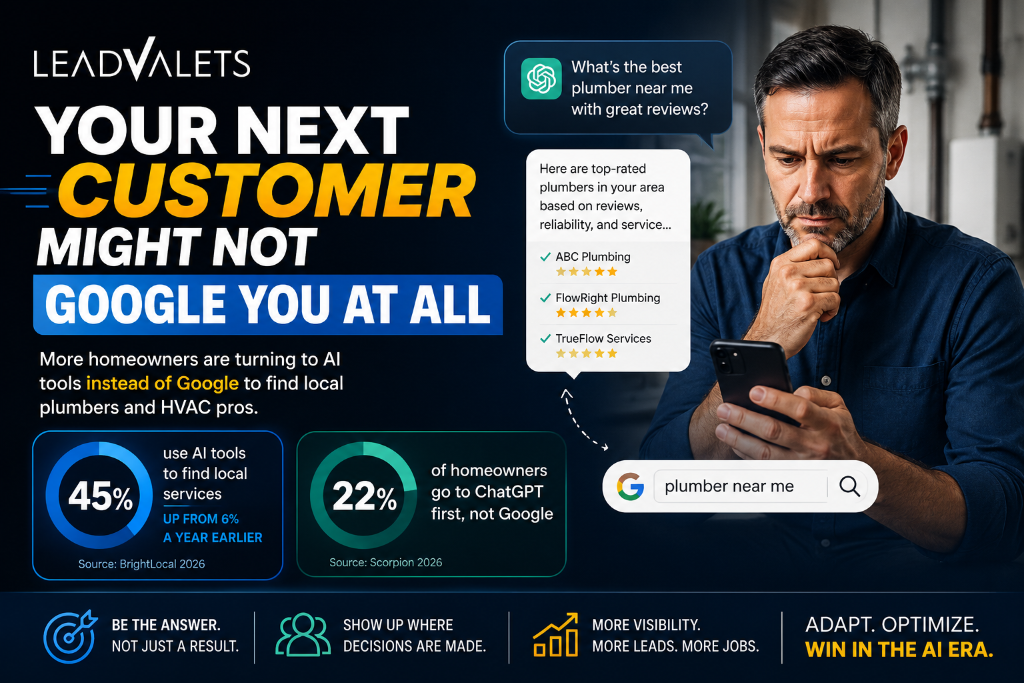
The way homeowners find a plumber or HVAC technician has changed faster than almost any other buying behavior in local services. A year ago, nearly all of that search activity happened on Google. Today, a meaningful and fast-growing share of it happens inside AI assistants - ChatGPT, Perplexity, Google's AI Overviews, and voice tools like Siri and Alexa - before a homeowner ever opens a search engine or a review site.
This shift matters because AI assistants don't work like search engines. They don't return ten blue links and let the homeowner decide. They return three to five recommendations, sometimes just one, and they build that shortlist from a different set of signals than traditional rankings ever used. A business that ranks well on Google can be entirely absent from an AI answer, and a business the homeowner has never heard of can be the only name mentioned.
This paper lays out what the data shows about this shift, explains - in plain terms - how AI assistants actually decide which local businesses to recommend, and outlines the practical gap most plumbing and HVAC companies now face. It closes with a straightforward framework for assessing where a business currently stands. Nothing here requires a vendor, a platform, or a purchase - only an honest look at how a business shows up in the places homeowners are increasingly asking first.
The Problem: A Second Search System Is Now Running in Parallel
For most of the last two decades, getting found as a local plumbing or HVAC company meant one thing: ranking in Google's local map pack. Businesses invested in Google Business Profile optimization, review generation, and local SEO because that's where the customer's attention lived. That strategy still matters. But it is no longer the whole picture.
A new category of search - often called AI search or answer engine search - has moved from novelty to mainstream behavior in the span of about a year. Homeowners facing a broken water heater or a failed AC unit are increasingly typing their question into a chat window instead of a search bar, and the assistant is answering with a direct recommendation rather than a list of links to evaluate.
This matters for every plumbing and HVAC business owner, regardless of company size, because the businesses being recommended inside those AI answers are not always the ones ranking highest on Google. The two systems weigh different evidence. A company that has spent years building a strong Google presence may find it has done almost nothing to earn a mention inside an AI-generated answer - and may not realize this gap exists until a competitor starts capturing that traffic instead.
It's also worth naming why plumbing and HVAC specifically sit at the center of this shift more than most other local trades. Both are emergency-adjacent services - a burst pipe or a dead furnace in January doesn't wait for a homeowner to compare five websites and read forty reviews. That urgency is exactly the condition under which people increasingly reach for a fast, conversational answer instead of a search results page: "my AC just went out, who should I call in [city]." An AI assistant that answers with a single confident name has a real advantage over a results page the homeowner has to sit and evaluate.
The Data: How Fast This Is Moving
Most home service businesses are, understandably, still oriented entirely around traditional search and review platforms. The problem is that the ground has moved.
A study on ChatGPT keyword behavior found that 75% of users still type keyword-style queries into AI tools, much like they would into a search engine. This is a useful, easily overlooked detail: homeowners are not abandoning search behavior when they move to AI assistants, they are simply moving the same habits to a new interface - one that answers differently.
The core problem this creates is straightforward: a business can be doing everything right by traditional local SEO standards and still be functionally invisible inside a growing channel of high-intent, ready-to-book customers. And because this shift is still new, most business owners have no visibility into whether it's already happening to them.
Traditional search offers ten chances to be seen on a single results page. AI search often offers three.
How AI Assistants Actually Decide Who to Recommend
Understanding this shift requires understanding a basic but under-discussed fact: AI assistants are not running the same ranking logic as Google's local map pack. They are pattern-matching across a completely different set of signals, and the businesses that win are the ones that happen to produce those signals clearly and consistently - often without knowing it.
Signal 1: Review Depth and Sentiment - Not Just Star Ratings
On Google, reviews function largely as a volume-and-star-rating signal. Inside AI systems, reviews are read more than they're tallied. Research on how Google's Gemini and AI Overviews systems operate confirms that these tools use review sentiment and keyword content, not just star ratings, to determine which businesses to recommend in AI-generated answers. A business with 40 four-star reviews that specifically describe "same-day emergency service" and "tankless water heater installation" is giving the AI system usable language to cite. A business with the same star rating but generic, one-line reviews is giving it nothing to work with.
It's also worth noting that the bar has risen. Review-count thresholds that used to sit around 10-15 reviews for strong local visibility have moved up to 25 or more in many markets as AI systems weigh review depth more heavily.
Signal 2: Cross-Platform Consistency (NAP)
AI systems evaluate a business's name, address, and phone number (NAP) across every platform where it appears - Google Business Profile, Yelp, industry directories, the business's own website - and check whether that information agrees. Analysis of how AI assistants build confidence in a business found that when multiple independent sources say the same thing, the model becomes more confident in that information and more likely to include it in a response. The inverse is also true: if an address is listed differently across platforms, that inconsistency reads as unreliability, and the AI system tends to simply exclude the business rather than try to reconcile the conflict.
Signal 3: Structured Data Accuracy
Behind the scenes, structured data markup (schema) is the technical layer that helps AI systems parse a website accurately - labeling services, service areas, business type, and FAQ content in a machine-readable way. Reporting on this topic found a specific and important failure mode: when structured data contradicts the on-page content, the Google Business Profile, or the reviews, the system doesn't attempt to reconcile the difference - it discounts the markup and often ignores the information altogether. In other words, structured data isn't a shortcut around inconsistency; it only helps when everything else already agrees.
Signal 4: Total Web Footprint
Perhaps the most important - and most discouraging - piece of evidence for independent plumbing and HVAC companies is the sheer scale gap between them and the lead-generation platforms competing for the same AI-generated answer. Analysis of AI visibility in the home services industry found that lead-gen platforms like Angi and HomeAdvisor have millions of indexed pages, while a local plumber might have 30 to 100 total web mentions across the entire internet. AI systems weight entities partly by how frequently they appear across training data, and that gap is larger in home services than in almost any other local industry.
This explains a pattern many business owners have likely already noticed without naming it: AI assistants defaulting to "check Angi" or "try HomeAdvisor" rather than naming an actual company by name, even a well-established one with a strong local reputation.
The Voice Search Dimension
The same dynamic shows up, in a more extreme form, on voice assistants like Siri and Alexa. When a homeowner asks a smart speaker to find a plumber, there is no screen to scroll - the assistant typically reads back one name, occasionally two. There is no "page two" on a voice query. This makes the consistency and citation signals described above even more decisive in that channel: a business either is the answer, or it is functionally absent from that entire mode of search. As more routine, low-stakes queries shift to voice interfaces over the next several years, the gap between "cited somewhere" and "the one name given" becomes the entire game, not just a nice-to-have.
The Conversion Advantage of Being the Top Recommendation
While roughly 80% of home service brands earn at least some AI citations, only 15% secure the top recommendation - and the businesses that do convert AI-driven traffic at 4.4 times the rate of traditional organic search. This tells two things at once. First, most businesses are already showing up somewhere in AI answers, whether they've tried to or not - visibility isn't the rare part. Second, being the one name recommended, rather than one of several mentioned, is worth disproportionately more than the equivalent traditional search ranking, because AI recommendations arrive with an implicit endorsement traditional search results don't carry.
The Five-Question Framework: Where Does Your Business Actually Stand?
None of the evidence above requires a new platform, a new vendor, or a purchase to act on. It requires an honest audit against five questions, each tied directly to a signal AI systems are already reading:
A business that can answer these five questions honestly has a clear, evidence-based picture of its current AI visibility - independent of anyone selling a solution to it. It's worth being clear about what this framework is not: it is not a guarantee that fixing these five areas produces a top AI recommendation on any fixed timeline. AI systems are updated frequently and their citation behavior shifts as they do. What the framework offers instead is a way to separate the signals that are within a business's control - review substance, consistency, structured data accuracy, web footprint, service-specific content - from the parts that aren't, so that effort goes toward what actually moves the evaluation.
Conclusion
The shift from typed search queries to AI-generated answers is not a future trend to prepare for - it is already underway, and the data suggests it is accelerating faster than most local service businesses have adjusted for. A jump from 6% to 45% in AI-tool usage for finding local services in roughly a year is not a gradual curve; it's the kind of shift that separates the businesses paying attention from the ones caught flat-footed.
The core takeaway is not that AI search is replacing Google - the evidence shows homeowners are still typing keyword-style queries even inside AI tools, so traditional search fundamentals remain relevant. The takeaway is that a second, differently weighted evaluation is now happening in parallel, built on review substance, cross-platform consistency, structured data accuracy, and total web presence - and most independent plumbing and HVAC businesses have no visibility into how they're performing against it.
The businesses that take the time to understand these signals now, before this becomes common knowledge across the industry, have a real window to be the name an AI assistant recommends - rather than the generic "try a lead-gen directory" answer that most contractors are currently getting by default.
For an owner or marketer who wants to act on this information directly, the most useful starting point is the five-question framework above, applied honestly to your own business this week: pull ten of your most recent reviews and check them for specificity, search your business name across the directories and platforms you're listed on and compare the details side by side, and ask someone unfamiliar with your business to describe, from your website alone, exactly which services you offer in which towns. That single exercise will surface more about your current AI visibility than any ranking report - and it costs nothing but an hour of attention.
Want to know exactly how your business appears - or doesn't appear - in AI search right now? Book a 15-minute Search Authority Review.
References
- How AI Search is Changing How Homeowners Find Contractors - Contractor Magazine: contractormag.com
- ChatGPT advertising for home services: How contractors win high-intent leads in 2026 - Stacker / Local News 8: localnews8.com
- ChatGPT Local Search: The Keyword Reality Contractors Need In 2026 - MarketingCode: marketingcode.com
- The Ultimate 2026 Google Business Profile Optimization Checklist - Reviewly.ai: reviewly.ai
- How AI Assistants Decide Which Brands to Recommend - General Dataworks: generaldataworks.com
- How Structured Data Supports Local Visibility Across Google and AI - Search Engine Land: searchengineland.com
- Why Doesn't AI Mention My Contracting Business? Home Services Visibility Data - Metricus: metricusapp.com
- Answer Engine Optimization Trends in 2026 - HubSpot: blog.hubspot.com
- Home Services Marketing Statistics: Ads, SEO & Leads (2026) - Click Vision: click-vision.com
Talk to LeadValets
Keep Reading
Related Articles
SEO vs AEO: Key Differences in AI Search
SEO helps pages rank in traditional search results, while AEO focuses on earning direct answers in AI search experiences. Explore how answer engine optimization works and why Google AI Overviews make it increasingly important.
Fastest Way to Rank in New Service Area: 7 Steps
The fastest way to rank in a new service area is to strengthen local relevance and trust before expanding your reach. Learn how to target the new city, optimize your local presence, and build credible local signals.
HVAC Rank Multiple Suburbs From One Office
An HVAC company can HVAC rank multiple suburbs from one office by building useful location pages for each service area and strengthening local signals. Keep business details consistent, earn genuine reviews, and avoid creating thin or duplicate pages.