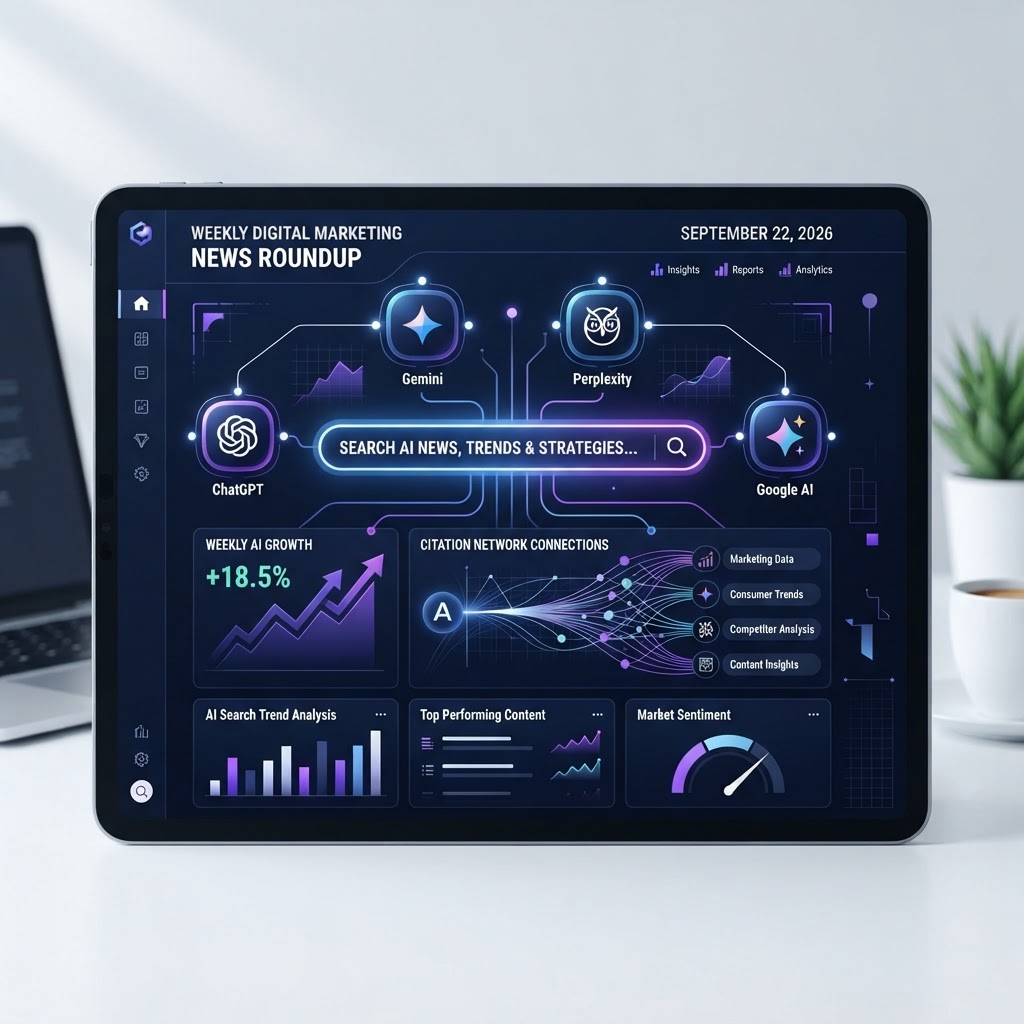
Google releases a new spam update on September 24, AI Mode begins booking appointments without users leaving search, 68 percent of brands are missing from AI recommendations, and the Google Ads AI Max migration closes September 30. Here is the marketing news that matters this week.
Google Search and SEO Updates
Google Rolls Out September 2026 Spam Update
Google officially confirmed a new spam update on September 24, 2026. The rollout is expected to take approximately two weeks to complete, finishing around October 8. This follows the August 2026 spam update, which concluded on August 21, and the June 2026 core update that caused significant ranking volatility across service business sites.
Early data from ranking-monitoring tools shows volatility beginning September 24 to 25, with the most noticeable fluctuations hitting sites that had recently acquired bulk low-quality backlinks or had thin service-area pages. Sites with strong content depth, clean link profiles, and well-structured Google Business Profiles appear to be holding steady.
Why it matters: If your plumbing, HVAC, or electrical site sees a sudden drop in rankings between September 24 and October 8, check Google Search Console for manual actions and review your backlink profile in Google's Links report. Do not make panicked changes during the rollout - wait until it completes to assess the full impact.
Google AI Mode Expands with Link Carousel Cards and Direct Booking
Google is aggressively expanding "AI Mode" within search results. The feature, partially powered by Gemini 3.8 Flash (the successor to 3.7), now includes link carousel cards for developing stories and, most significantly, direct booking capabilities for local service businesses. When a user searches for a plumber or HVAC company in AI Mode, Google can now compare options, make a recommendation, and facilitate an appointment booking - all within the search interface, without the user ever visiting a website.
This is the most significant shift in local search behavior since the introduction of the Map Pack. Google is testing booking integration with major scheduling platforms including Calendly, Housecall Pro, and ServiceTitan, with expansion to additional scheduling providers expected throughout Q4 2026.
Why it matters: Ranking in the Map Pack is no longer the final goal. Your business data - NAP consistency, service area definitions, pricing transparency, and booking calendar integration - must be structured so AI can extract it and act on it. If your scheduling software is not connected to your Google Business Profile, you are invisible to this booking flow.
Google Introduces New 'goto' URL Parameters
Google has introduced new "goto" URL parameters in search result URLs. These parameters appear to be designed to manage how third-party tools scrape and display search data, and they may be part of Google's broader effort to block automated rank-tracking tools and AI scrapers that began around September 13.
Early analysis suggests the parameters redirect through Google's own servers before reaching the destination site, which could affect how third-party SEO tools report referral traffic. Some rank-tracking tools have already reported data discrepancies since the parameters were introduced.
Why it matters: If you use third-party rank-tracking or SEO monitoring tools, verify that your data collection has not been disrupted. The parameters may also affect how Google Analytics attributes organic search traffic, so watch for changes in your source and medium reporting.
Google Business Profile Spam Review Alerts Now Live
Google is now sending email notifications to business owners when its spam systems detect a spike in spam reviews on a Google Business Profile. This proactive alert system, first reported last week, is now fully live for all business categories. The alerts include a direct link to review management tools where owners can flag suspicious reviews for removal.
Why it matters: Review spam is a growing problem for service businesses, particularly in competitive markets where competitors may plant fake 1-star reviews. Enable email notifications in your Google Business Profile settings and respond to alerts within 48 hours to maximize the chance of spam removal.
AI Search Visibility: The New Frontier
68 Percent of Brands Are Missing from AI Recommendations
New research published this week found that 68 percent of brands are currently missing from AI recommendations across ChatGPT, Gemini, Perplexity, and Google AI Overviews. This builds on the September 22 finding that 73 percent of page-one Google brands get zero AI mentions, and the SOCi 2026 Local Visibility Index finding that 98 percent of local business queries produce zero AI citations for the tracked business.
The data reveals a widening gap between brands that have invested in Answer Engine Optimization and those that have not. Brands with structured data, consistent NAP information across directories, and active review velocity are cited 3 to 5 times more often than brands relying on traditional SEO alone.
| Signal | Data Point |
|---|---|
| Brands missing from AI recommendations | 68 percent |
| Local business queries with zero AI citations | 98 percent |
| Page-one Google brands with zero AI mentions | 73 percent |
| Citation boost from structured data | 3 to 5x |
| Schema-marked pages cited more often | 2.3x |
The bottom line: If your business is not investing in AI search visibility, you are invisible to more than two-thirds of AI recommendation queries. The gap between AEO-active and AEO-inactive brands is compounding monthly - every week you wait makes the gap harder to close.
Google AI Now Compares Options and Books Appointments Directly
The most significant AI search development this week is Google's expansion of AI Mode to include direct comparison and booking. When a user asks "Who is the best plumber near me?" or "Which HVAC company should I call for AC repair?", Google AI Mode now:
- Compares 3 to 5 local businesses based on reviews, response time, service area, and pricing transparency
- Generates a recommendation with reasoning ("Company A has 4.8 stars, responds within 2 hours, and offers upfront pricing")
- Offers a direct booking button that connects to the business's scheduling platform
- Completes the booking without the user leaving Google
This means a homeowner can go from search query to booked appointment without ever visiting your website. Your website is no longer the conversion point - it is the data source that feeds the AI's decision.
Why it matters: Your Google Business Profile, service area definitions, pricing pages, and booking integration are now your primary conversion assets. If your GBP is incomplete, your service area is ambiguous, or your pricing is not published, the AI cannot confidently recommend you. Invest in structured, machine-readable business data before anything else.
ChatGPT Market Share Continues to Fragment
Comscore data through late September shows ChatGPT's share of AI prompts has declined further from 50 percent to approximately 46 percent, while Gemini, Claude, and Perplexity continue gaining ground. Gemini's share rose to 22 percent, Claude to 16 percent, and Perplexity to 11 percent. The remaining 5 percent is split among Grok, Copilot, and DeepSeek.
BrightEdge's latest B2B brand-mention study found that ChatGPT now names 31 percent fewer B2B tech brands per answer compared to the start of 2026, while Gemini names 18 percent more. Perplexity remains the highest-citation engine with 93.2 percent of answers carrying at least one citation, but its referral share has stabilized at approximately 4 percent.
What this means: The AI search market is fragmenting further. No single engine dominates. You must track visibility across at least four engines - ChatGPT, Gemini, Perplexity, and Google AI Overviews - to understand your full AI visibility. Each engine uses different retrieval sources and citation logic, so a one-size-fits-all GEO strategy will not work.
Google Publisher Payment Pilot Expands to More Publishers
Google's publisher payment pilot, which compensates publishers whose content is used to generate AI answers in Gemini, AI Mode, and AI Overviews, expanded this week to include additional publishers. While the program remains limited to large publishers, Google confirmed it is exploring a tiered model that could extend to mid-size and local publishers in 2027. This represents the first concrete revenue-sharing model for AI-sourced content.
Google Ads and Local Services Ads Updates
Google Ads AI Max Migration Closes September 30
Google is completing the migration of Search campaigns to the new "AI Max" reporting and management framework by September 30, 2026. This unified reporting structure consolidates performance data across AI-driven ad placements, including AI Overviews ad slots, AI Mode placements, and traditional Search ads.
Key changes with the AI Max migration:
- Campaign-level language settings are now fully automatic, matching ad creative to the user's search-term language
- Reporting is consolidated across all AI surfaces (AI Overviews, AI Mode, traditional Search)
- Smart bidding strategies now factor in AI Overview placement performance
- Historical campaign-level language data will not carry over in the new reporting structure
Why it matters: Audit your Google Ads accounts before September 30 to ensure the automated migration does not disrupt budget allocation or lead quality. Export historical campaign-level language data before the migration completes, as it will not be available in the new AI Max reporting structure.
Local Services Ads: Missed Calls Become Billable October 1
As reported last week, starting October 1, 2026, certain Local Services Ads categories will begin charging for missed calls as billable leads. Previously, only answered calls counted as billable leads. This is now 3 days away.
For HVAC, plumbing, and electrical companies using LSAs, this change directly increases lead costs if your call-answering practices are poor. A missed call that previously cost nothing will now be charged at the standard LSA lead rate, which ranges from $15 to $75 per lead depending on category and market.
Why it matters: If you have not already done so, implement call-answering systems immediately: call forwarding to mobile phones, dedicated answering services, or virtual receptionists. A single missed call per day at $40 per lead adds $1,200 per month in wasted LSA spend.
Google Ads Adds Local Customer Optimization for Performance Max
Google Ads released two new features for multi-location businesses this week: Local Customer Optimization (a PMax toggle that prioritizes budget across Google Maps, Waze, and local Search) and Store Sales in Data Manager (link CRM or Google Sheets for in-store data optimization). These features are now available in all accounts using Performance Max campaigns with location assets.
YouTube and Creator Economy Updates
YouTube TV Loses Three Channels September 30
As reported last week, YouTube TV will remove Tastemade, Court TV, and The Young Turks from its lineup on September 30, 2026. Recordings from these channels will not remain available after that date. This is now 2 days away - advise any clients or team members who watch these channels to finish their recordings before the removal.
YouTube Expands Creator Partnerships with Gemini-Powered Matching
YouTube's Creator Partnerships platform, which replaced BrandConnect earlier this month, is now fully live. The Gemini-powered platform moves brand-creator deals entirely inside Google Ads and Display and Video 360, giving brands access to over 3 million YouTube Partner Program creators. The AI matching system uses audience demographics, content themes, and campaign goals to recommend creators for brand partnerships.
Why it matters: For home service brands looking to build local authority, YouTube creator partnerships are an underused channel. A local HVAC company sponsoring a regional home-improvement creator can build brand awareness that translates into AI citation authority - AI engines reference YouTube content in their recommendations.
HVAC and Local Service Business Marketing Snapshot
For HVAC, plumbing, and electrical companies, this week's news reinforces three priorities:
- AI booking is here. Google AI Mode can now book appointments directly. If your scheduling software is not connected to your Google Business Profile, you are losing bookings to competitors who have integrated.
- The spam update may shake rankings. Monitor Search Console through October 8. If rankings drop, check for thin service-area pages, low-quality backlinks, or duplicate content.
- Missed LSA calls cost money starting October 1. Three days from now, every missed call becomes a billable lead. Implement call-answering systems this week.
The average HVAC cost per lead remains $153 industry-wide, ranging from $18 for SEO-generated leads to $150+ for PPC. With LSA missed calls becoming billable, the effective cost per lead for businesses with poor call-answering practices will rise significantly. A 4.5+ star rating correlates with 12 to 25 percent higher close rates, making review velocity the single highest-ROI activity for service businesses this quarter.
What This Means for Marketers: Weekly Takeaways
-
Connect your scheduling software to your Google Business Profile this week. Google AI Mode can now book appointments directly from search results. If your booking calendar is not integrated, you are invisible to this flow.
-
Monitor Google Search Console through October 8. The September 24 spam update is rolling out for two weeks. If rankings drop, check for thin service-area pages, low-quality backlinks, or policy violations - do not make panicked changes during the rollout.
-
Implement call-answering systems before October 1. Local Services Ads missed calls become billable leads in 3 days. A single missed call per day at $40 per lead adds $1,200 per month in wasted spend.
-
Audit your AI Max campaign structure before September 30. The Google Ads AI Max migration closes this month. Export historical campaign-level language data before the migration completes.
-
Invest in structured data for AI visibility. 68 percent of brands are missing from AI recommendations. Schema-marked pages are cited 2.3x more often. Deploy Article + ItemList + FAQPage schema on key content pages immediately.
-
Track visibility across four AI engines, not just ChatGPT. ChatGPT's market share has fallen to 46 percent. Gemini (22 percent), Claude (16 percent), and Perplexity (11 percent) all matter. Each engine uses different citation logic - a one-size-fits-all strategy will not work.