
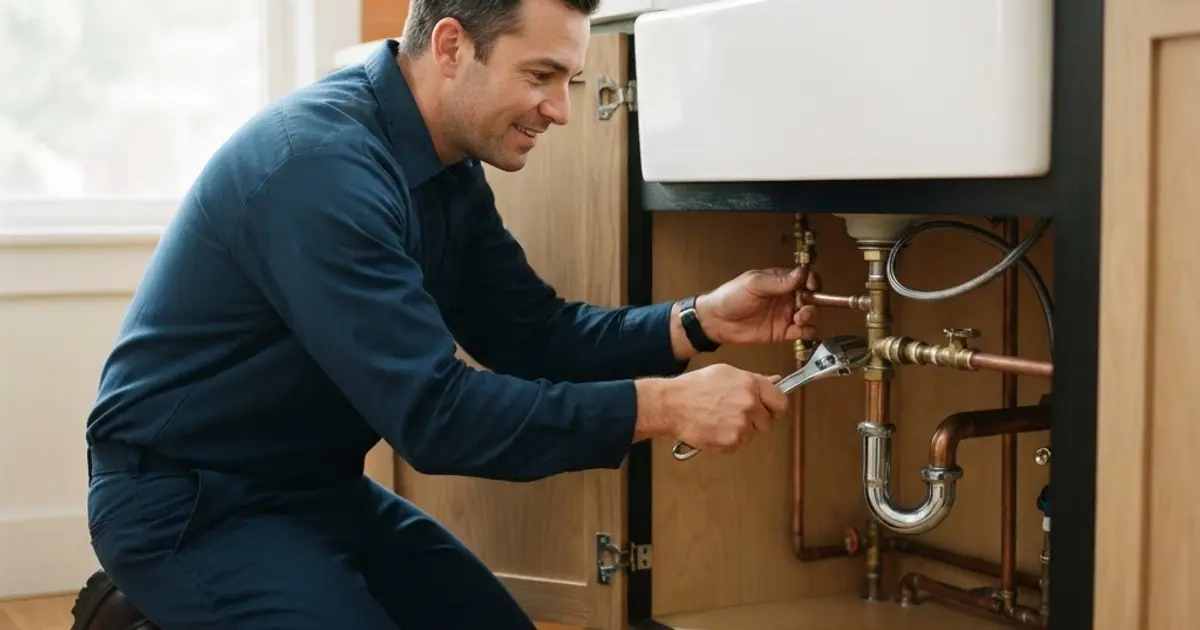
To grow a plumbing business, fix the cheapest leak first, then work outward: book the calls you already get, price each job to make money, get found on the map, earn steady reviews, and hire before the board is full. Most advice starts with buying more leads. I'd start with the calls you already paid for.
I've spent more than 35 years in sales and marketing, and I founded LeadValets in 2018. The pattern rarely changes: an owner adds a truck, buys more leads, and watches the new calls ring out at 4:45 on a Friday.
TL;DR
- Growth is booked jobs times average ticket, so track 4 numbers before you spend: calls, booking rate, average ticket, and cost per booked job.
- Fix the phone before you buy traffic, because Google's own Local Services Ads rules say missed calls can count against how your ad ranks.
- In BrightLocal's 2026 survey of 1,002 US adults, 47% said they'd pass on a business showing fewer than 20 reviews.
- The Bureau of Labor Statistics projects about 42,000 plumber openings a year through 2035, so start recruiting before you need the tech.
- Search work typically takes 90 to 120 days to show up in calls, so buy speed with ads only while the cost per booked job leaves a margin.
Start with a baseline. Before you change anything on this list, find out what Google and the AI engines can already check about your company. The free Search Authority Audit scans up to 5 pages and returns a 100-point score with a 30-day action plan: Run My Free Search Authority Audit.
Find the Constraint That Caps Your Growth
Your shop grows only as fast as the weakest of four stages: getting the call, booking the call, selling the job, and having a tech to send.
Here's the arithmetic with made-up round numbers and a $400 average ticket:
| Scenario | Calls a month | Booking rate | Booked jobs | Revenue |
|---|---|---|---|---|
| Today | 200 | 50% | 100 | $40,000 |
| Book more of the same calls | 200 | 60% | 120 | $48,000 |
| Buy 20% more calls | 240 | 50% | 120 | $48,000 |
Both changes add 20 jobs and $8,000 a month. Only the second one made you pay for new calls.
Swap in your own numbers from last month's call log and invoices, then match your shop to one of these:
- Calls. The phone is quiet, and a truck sits in the lot.
- Booking. The phone rings, and the calendar still has holes in it.
- Selling. Techs run plenty of calls, but tickets are small, and estimates die on the kitchen table.
- Capacity. You're booked out two weeks and turning work away.
Pick the one that describes last month. That's where your next dollar and your next hour belong.
How to Grow a Plumbing Business in 7 Steps
Work these seven steps in order, because each one makes the next one cheaper. A shop that books and prices well gets more out of every review, every ad, and every new hire.
1. Know Your Four Numbers Before You Spend
Start with four numbers from last month, because without them every growth decision is a guess with a truck payment attached. Pull them from records you already have:
- Calls: total inbound calls, split by where each one came from.
- Booking rate: booked jobs divided by the calls that asked for service.
- Average ticket: revenue divided by completed jobs, with service calls and installs kept apart.
- Cost per booked job: what you spent on a channel divided by the jobs that channel booked.
The last one matters most. I've put it bluntly on our own cost page: "Cost per lead is a vanity number."
Here's why, using assumed close rates:
| Lead price | Jobs booked | Cost per booked job |
|---|---|---|
| $30 | 1 in 25 | $750 |
| $200 | 3 in 10 | About $667 |
The expensive lead turns out to be the cheaper customer.
Your close rates will differ, which is the reason to measure them. Once you know your cost per booked job by channel, you know which channel has earned the next dollar.
2. Answer and Book Every Call You Already Get
Fix the phone before anything else, because every missed call is one you already paid to create.
Two sources back that up:
- Google. Its help page on how Local Services Ads are ranked lists responsiveness among the inputs and says missed calls may count against you.
- Harvard Business Review. Its researchers wrote back in March 2011 that most companies answered online inquiries far too slowly.
What I'd put in place this month:
- A live person answers during business hours, with a backup line when the office is on another call.
- After hours, calls go to an on-call tech or an answering service that can book a slot.
- Every missed call gets a callback within the hour, and one person owns that list.
- Whoever answers gets the name, the address, and the problem, then offers two time slots.
- Missed calls are counted weekly and reviewed like any other number.
The one-hour callback window is my own rule of thumb. I haven't seen a current primary study that puts a number on response time for home services, so I won't quote one.
3. Price Every Job to Make Money
Raise prices before you add volume if your current jobs don't cover what a truck costs to run. More calls at a losing price only lose money faster.
Work out your loaded cost per truck hour first. Add these up, then divide by the hours you can bill:
- Tech wages and benefits
- The van, fuel, and insurance
- The office and software
- Callbacks
- Your own pay
Then build a flat-rate menu from that number:
- Quote the whole job up front, so the customer isn't watching an hourly meter.
- Offer two or three options on bigger work, such as a repair, a longer-lasting repair, or a replacement.
- Re-check the menu whenever wages, parts, or insurance move.
- Track average ticket by tech, so training goes where the gap is.
I can't hand you a target margin, since that depends on your market, your mix of service and install work, and your debt. What I can say is that a shop without a truck-hour cost is setting prices by watching the company down the road.
4. Make Your Company Easy to Find on the Map
Complete your Google Business Profile before you spend on ads, because that profile is what Google shows when a homeowner nearby searches for a plumber.
Google's own page on how local ranking works tells an owner three things:
- Local results rest mainly on relevance, distance, and popularity.
- A better local position can't be requested or bought. Read that again as a contractor: nobody can sell you a spot on the map.
- Popularity includes reviews, ratings, and other websites that link to you.
You can't move distance, so work on the other two:
- Choose the primary category that matches your main work, then list every service you want calls for: drain cleaning, water heater replacement, repipes, sewer line work.
- Set your true service area and your real hours, including emergency hours if you run them.
- Add photos of your trucks, your crew, and finished jobs, and keep adding them.
- Give each main service its own page on your website, written from jobs your techs have run.
- Check that your name, phone, and address match wherever your company is listed.
Homeowners also ask AI assistants who to call. The work is to make your company easy for Google and the AI engines to verify. Whether an engine names you is its decision.
Measure all of it in calls. Before you judge the work, set things up so you can track calls from your profile and see which ones the listing produced.
5. Earn Reviews Steadily and Legally
Ask every customer for a review after every job, and never pay for one.
Buyers read them. BrightLocal's 2026 Local Consumer Review Survey asked 1,002 US adults:
- 47% said they'd pass on a business showing fewer than 20 reviews.
- 74% said only reviews from the past three months count for them.
Treat those as stated habits. The survey covers every kind of local business, and what people tell a researcher can differ from what they do with a flooded basement.
Two sets of rules apply, starting with the FTC's Consumer Reviews and Testimonials Rule:
| Rule | What it bars |
|---|---|
| FTC rule, in effect since October 21, 2024 | Fake reviews and rewards tied to a review expressing a particular sentiment. Courts can impose civil penalties for knowing violations |
| Google's Maps policy | Payment, discounts, or free services for any review. Asking only happy customers. Telling a customer what to write |
So keep the routine simple:
- The tech asks at the door, and the office texts the link the same day.
- Every customer gets the same ask, including the ones who grumbled about the price.
- No gift cards, no discounts, no prize drawings.
- The customer writes the review in their own words.
- You reply to each one, because the next customer reads your replies.
There's no universal review count to hit. Look at the three companies in your map pack, see how many reviews each holds and how recent they are, and set your pace to match.
6. Build Repeat Work With Service Agreements
Give past customers a reason to call you first, since you've already paid once to win them.
A service agreement does that. Keep the offer plain: an annual water heater flush, a drain and fixture check, priority scheduling, and a member price on repairs.
The agreement also steadies the slow weeks. Scheduled maintenance visits fill the board when emergency calls dip, and each visit puts a tech in front of a customer who already trusts you.
Three habits make the program work:
- Offer the agreement on every call, in the same words, and track how many each tech sells.
- Keep one clean customer list in your field service software, with the install date of every water heater you put in.
- Send reminders by email or text only to customers who agreed to get them. Consent and opt-out rules apply to marketing messages, so check the FTC's guidance before you send.
Ask for referrals too, and keep that ask apart from any review request, because Google's policy bars rewards for reviews.
7. Hire and Train Before the Board is Full
Start recruiting before you need the tech, because demand for plumbers is growing faster than for most occupations.
The Bureau of Labor Statistics projects 7% growth in plumber employment between 2025 and 2035. Its numbers for an owner:
- Growth: 7%, which the agency rates as much faster than average.
- Openings: about 42,000 a year, many of them to replace people who retire or change careers.
- Pay: a 2025 median of $63,800 a year. Half of the trade earns more, so treat that as a starting point for your budget.
Those figures are national, and they group plumbers with pipefitters and steamfitters. Your county may be easier or harder to hire in.
What I'd do before the board fills:
- Keep a job posting open all year and talk to every solid applicant.
- Bring on an apprentice while your lead tech still has time to teach.
- Write down how your shop runs its ten most common jobs, so a new hire learns your way.
- Train techs to explain options and prices as carefully as they sweat a joint.
- Move your best tech toward a field supervisor role, so you can get off the truck.
That last move is the hard one. An owner who is still the best tech on the crew is also the ceiling on the company.
Want a second set of eyes on your market? Bring your call numbers and the hardest question you have about where to spend next. I'll give you a straight answer in a short call: Book My 15-Minute Search Authority Review.
Choose Marketing Channels by Cost Per Booked Job
Judge each channel by what one booked job costs, how fast the calls arrive, and what you still own when you stop paying.
| Channel | How you pay | How fast calls arrive | What you keep |
|---|---|---|---|
| Repeat customers and referrals | Your time and your service agreements | Right away, limited by the size of your customer list | The relationship |
| Google Business Profile, website, and reviews | Monthly work, in-house or hired | Slower. Most clients see results over the first few months | The profile, the site, and the reviews |
| Local Services Ads | Per lead, up to the bid you set | Fast while the budget runs | Nothing once you stop |
| Google search ads | Per click | Fast while the budget runs | Nothing once you stop |
| Lead marketplaces | Per lead, often shared with other contractors | Fast | The lead and nothing else |
| Truck wraps, yard signs, direct mail | Up front | Slow and hard to trace to a call | Name recognition in the neighborhood |
How I'd read that table:
Paid channels buy speed. Search and reviews build an asset you keep. Many shops need both for a while, with ads covering the months before the map and the website start producing.
Marketplace leads are often shared. Several contractors get the same lead at once, so expect a lower close rate than on a call that came straight to you. Keep buying while the cost per booked job leaves a margin, and stop when the margin is gone.
Local Services Ads are pay-per-lead. Google's help page says your bid is the most you'll pay for one. If you're weighing Local Services Ads or SEO, run both through the same arithmetic.
We built LeadValets around the owned side. We do marketing for plumbers with one plumbing company per service area, and we report the work in tracked calls.
Expand Services and Service Area Last
Add a new service or a new town only after the core shop books, prices, and staffs its current work cleanly. Expansion multiplies whatever you already are, including the leaks.
New services work best when they sit next to jobs you already run:
- Water heater replacement can lead into tankless installs.
- Drain cleaning can lead into camera inspections and sewer line work.
- Service calls can lead into water treatment and filtration.
Check three things before you sell the first job in a new line or a new town:
- Licensing. Licensing and advertising rules for contractors vary by state, so confirm what your state requires for each new line of work.
- Distance. Distance is one of Google's three local factors. A profile based across the county has to earn its place in the next town with reviews from customers there and pages about work you've done there.
- Google's guidelines. They rule out a virtual office for a service-area business unless someone actually works there during business hours. They also say a service area shouldn't stretch much past about 2 hours of driving time from your base.
Cut the Spending That Never Books a Job
Stop paying for four things first: traffic your office can't answer, map positions someone claims to sell, reviews that break the rules, and reports with no calls in them.
- More leads while calls go unanswered. Fix step 2, then buy.
- A promised map position. Google says a better local ranking can't be requested or bought, so a promise of one is a promise nobody can keep.
- Review schemes. Gift cards for five stars, asking only happy customers, and reviews from employees or family run into the FTC rule, Google's policy, or both.
- Reports with no calls in them. Ask anyone you pay for marketing to show calls by source every month. If the report can't say which calls the work produced, I'd question the invoice.
None of that means cutting a channel on a hunch. Run the arithmetic first, then cut what the numbers won't defend.
Set a Realistic Growth Timeline
Phone and pricing fixes pay on the very next call, and search visibility takes a season.
| What you change | When it shows up |
|---|---|
| Booking script and callbacks | This week, on the next call |
| Price menu | This month |
| Map, website, and reviews | Most clients see results over the first few months |
| A new apprentice | Longer. The BLS lists apprenticeship as the usual training path |
That is a typical range, and nobody controls Google or the AI engines.
Here is one documented example. STL Air Pros, a St. Louis HVAC company, went from about two calls a month to more than 111 in roughly eight months, as documented in that client's case study.
One client in one market is no forecast for a plumbing shop in yours.
If you need calls next week, paid ads are the faster fix, and I'll tell you so.
Know When More Marketing is the Wrong Fix
More marketing won't help when the problem sits after the phone rings. Three cases come up often:
- Your phones ring and jobs still don't close. That's a sales or dispatch problem, and more traffic only makes the problem more expensive.
- Your board is already full. Calls you can't serve become missed calls and unhappy callers.
- You need revenue this week. Search compounds over months, so use ads or your past-customer list.
I should also be straight about what the evidence can't tell you:
- Google names its local ranking factors and keeps the details confidential, so nobody outside Google knows the weights.
- The BLS numbers are national, and the BrightLocal figures are survey answers.
- The order of the seven steps is my judgment from the shops I've worked with. No controlled study ranks them.
If your numbers point to a different weak spot, follow your numbers.
Start With These Five Moves This Week
Five small jobs will show you where your shop is stuck within a week.
- Pull last month's calls, booked jobs, and invoices, and write down your booking rate and average ticket.
- Count missed calls for 7 days, and call each one back within the hour.
- Open your Google Business Profile and fill in every service, your hours, and your service area.
- Text a review link to every customer from the last 7 days, with no reward attached.
- Price your 10 most common jobs against your loaded cost per truck hour.
Frequently Asked Questions
Here are short answers to the growth questions plumbing owners ask me most.
How Much Should a Plumbing Company Spend on Marketing?
No single percentage fits every shop. Work backward: decide how many more booked jobs you can staff, multiply by what a booked job costs on each channel, and cap the spend where the margin runs out.
Should I Raise Prices or Add a Truck First?
Prices first, in most shops I see. A second truck adds overhead to jobs that may already lose money, so confirm each ticket covers its truck hour before you buy the van.
Do I Still Need a Website if My Google Business Profile is Complete?
Yes. Google counts links from other websites toward how well known your company is, and your site is where a homeowner checks your services and service area before calling.
Are Lead Marketplaces Worth It for a Growing Plumbing Company?
Sometimes. Shared leads go to several contractors at once, so run the cost per booked job at your real close rate and keep buying only while that number leaves you a margin.
How Many Google Reviews Does a Plumbing Company Need?
No universal number exists. Count the reviews held by the three companies in your map pack, note how recent theirs are, and keep a steady pace that matches them.
Conclusion
Growing a plumbing company is a sequence: know the numbers, book the calls, price the work, get found, earn the reviews, keep the customers, and staff ahead of demand. Skip a step, and the next one costs more.
See where you stand first. The free Search Authority Audit takes about two minutes, scans up to 5 pages, and returns a 100-point score with a 30-day action plan: Run My Free Search Authority Audit.
Prefer to talk? Call 314-561-7101.
About the author
Jonathan Floyd is the Founder and President of LeadValets and the creator of the Search Authority Flywheel, the framework his team uses to build local visibility across Google Business Profile, Google Maps, and AI search. He has spent more than 35 years in sales and marketing. He will also tell you when local search isn't going to move your numbers.