
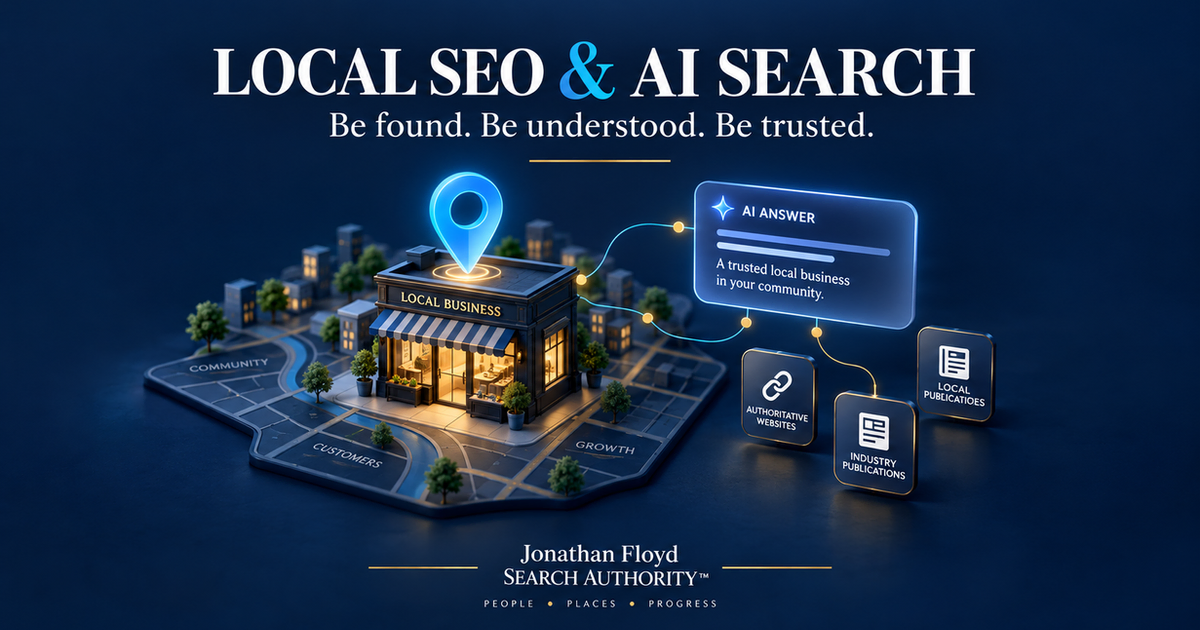
Local businesses can strengthen their search presence by keeping their Google Business Profile accurate, building a useful and technically accessible website, and earning credible recognition beyond their own pages. When an existing business relocates, Google's published guidance is to update its existing profile. For AI search, sound SEO remains foundational, while relevant third-party coverage can provide additional information about the business.
A business owner does not need another marketing acronym to worry about before breakfast.
You need customers to find you, understand what you do, and feel comfortable calling. That is true whether they discover you through Google Maps, a traditional search result, or an AI-generated answer.
Three issues deserve attention: moving a Google Business Profile, separating useful AI search work from repackaged SEO, and building a reputation across websites you do not own.
They connect through a practical principle: make your business easy to identify and your claims easy to verify.
If your address is wrong, a customer may drive to the wrong building. If your service pages are vague, a prospect may never understand why you are a good fit. If the only website saying you are an expert is your own, a buyer has little outside evidence to consider.
Here is how to improve all three without turning your marketing budget into a science experiment.
How should you move a Google Business Profile?
For an existing business relocating to a new address, update the current Google Business Profile. Do not create a replacement profile simply because the address changed. Google states this directly in its guidance on duplicate profiles. A relocation is different from opening an additional eligible location or establishing a different business. [1]
That distinction matters because advice sometimes circulates that a major move requires creating a new profile, closing the old one, and merging the two. That is not Google's published general relocation process. If support gives instructions for a particular case, confirm which profile should survive and how reviews will be handled before taking action.
Your moving company handles the furniture. Somebody still needs to handle the digital address book.
For a deeper look at keeping your profile competitive in the map pack, see our Google Business Profile management guide for the map pack in 2026.
Start by identifying what is actually changing
Before editing anything, write down the situation:
- Relocation: The same business is moving its operating location.
- Expansion: The existing location remains open and an additional location is being established.
- Business change: The move also involves a substantial change in identity, ownership, or services.
For an expansion or a major identity change, check eligibility and representation rules before deciding which profiles belong online. A new lease by itself does not establish eligibility for an additional listing. [2]
Use this practical relocation checklist
- Record the starting point. Save the profile URL, business details, review count, and screenshots. Record recent calls, website visits, and qualified leads so you have a useful comparison after the move. This is a recordkeeping recommendation, not a Google requirement.
- Update the address on the existing profile. In the profile editor, open the location information, enter the correct address, and check the map pin. Google's address instructions explain the editing process. [3]
- Set address visibility according to how you serve customers. A service-area business that visits customers and does not receive them at its base should hide its address. A qualifying storefront or hybrid business can display its customer-facing location. Do not use address visibility as a ranking trick. [2]
- Complete verification. Google says a verified business that changes its address must verify again. Follow the method presented for your profile and make sure the information you provide reflects the actual business. [4]
- Update the places customers check. Review your website's contact page, footer, map embeds, appointment instructions, major business listings, and relevant professional directories. For a home-based service business, preserve address privacy while correcting misleading public location claims.
- Check the customer experience. Search your business name, open the public profile, test the website link, and inspect directions where appropriate. Confirm that a customer can reach the right business without detective work.
- Keep a change log. Record edits and support case numbers. If incorrect information persists, provide support with the profile URL, screenshots, and a clear description of the issue instead of repeatedly creating new listings.
Why might the old location still appear?
Google explains that business information comes from multiple sources, including websites, licensed data, and user contributions. An owner's edit is therefore not the only information associated with a business. [5]
That makes outdated references worth investigating. An old contact page, an incorrect directory listing, or a duplicate profile can present conflicting information. This is a diagnostic possibility, not proof that any particular listing caused a ranking problem.
Search for your business name alongside the old address. Correct the sources you control and request updates from relevant publishers. Prioritize pages customers actually encounter rather than paying to change hundreds of obscure listings without a clear reason.
A ranking change does not automatically mean the move failed
Google identifies relevance, distance, and prominence as central local ranking factors. Moving changes your distance from potential customers. [6]
Consider a hypothetical HVAC company moving from one side of a metro area to another. Its visibility could improve near the new base and decline around the previous one even if its information is correct.
For that reason, compare performance across the areas you serve. One search from the owner's phone is not a complete local visibility report.
The business question is whether suitable customers can find you and book work in the territory you can realistically serve.
Is GEO different from SEO?
GEO means generative engine optimization: work intended to improve visibility in AI-generated responses. Much of that work overlaps with SEO, especially in Google Search. The useful distinction is the outcome being measured, not the novelty of the acronym.
Google's own generative AI optimization guide says its AI search features rely on core Search ranking and quality systems. From Google Search's perspective, optimizing for these experiences remains SEO. [7]
That does not mean every AI platform retrieves information the same way, or that a high organic ranking guarantees an AI citation. It means a business should demand a clear explanation of what an AI visibility service will actually improve.
For a detailed breakdown of how AI answer engines differ - and what actually earns citations - read our guide to answer engine optimization across ChatGPT, Claude, Gemini, and Perplexity.
Understand the terms before buying the service
| Term | Practical focus | Business question |
|---|---|---|
| SEO | Discoverability and performance in search engines | Can relevant prospects find our pages? |
| Local SEO | Visibility for location-based searches and local business results | Can nearby customers find and evaluate us? |
| AEO | Making answers clear and accessible in answer-driven experiences | Do we answer the questions buyers need resolved? |
| GEO | Visibility, mentions, and citations in generated answers | Are AI responses accurately including or referencing us? |
These are working definitions. They describe overlapping work rather than four independent marketing machines.
For an owner, the distinction is useful when it clarifies deliverables. It is less useful when it turns the same five tasks into four invoices.
Build pages that help a customer make a decision
Start with the questions that come up during estimates and sales calls. A useful service page should explain:
- What problem the service solves.
- Who the service is suitable for.
- What affects price, timing, or scope.
- Where the business actually provides it.
- What evidence supports its claims.
- What happens after someone contacts the company.
For example, a plumbing page could explain which conditions make drain cleaning insufficient and when a camera inspection may be appropriate. A roofing page could describe the information needed before an estimate can be reliable.
These are suggested content angles, not substitutes for qualified technical advice. Have the appropriate specialist review claims in their field.
The benefit is practical: a prospect arrives with a better understanding of the service, and your sales conversation can address fit rather than start from zero.
Use evidence that another business cannot simply copy
Google recommends useful content with original experience and perspective, rather than interchangeable summaries. [7]
For a local company, that might mean a documented project explanation, original photographs used with permission, or an honest account of how a recommendation changed after an inspection.
A strong project story can describe the customer's initial concern, what the team found, what options were considered, and why a particular solution was chosen. Include limitations and measured outcomes when available.
Avoid inventing results to make the story sound impressive. A believable explanation of one real job is more useful to a buyer than a page full of unsupported superlatives.
Keep the technical foundation accessible
Google's AI feature documentation emphasizes crawl access, internal links, important information in text, and structured data that matches visible content. It does not require a special AI text file or special AI schema. [8]
Ask your web team to check the pages that matter commercially. Can search systems access their main content? Do relevant pages link to them? Can a mobile visitor read the page and contact the business easily?
Keep the discussion tied to a specific problem and a verifiable fix. "We optimized your AI readiness" is less useful than "We removed an accidental indexing block from your furnace installation page."
What does academic research actually establish?
Aggarwal and colleagues introduced a framework for studying generative engine optimization in research accepted at KDD 2024. They reported visibility improvements of up to 40% in their experimental setting and found that effectiveness varied across domains. [9]
That supports taking AI visibility seriously as a subject of measurement and experimentation. It does not establish that every local business can gain 40% more traffic, citations, or revenue by applying a standard checklist.
An experimental visibility metric is not a booked appointment. Treat research as a basis for careful testing, not a number to paste into a sales guarantee.
How can off-site mentions support AI visibility?
A relevant third-party mention can provide additional information about who a business is and what it does. If an AI search system retrieves that source, the information may help inform its response. That is a plausible mechanism, not a universal promise that every mention improves AI rankings.
Google describes retrieving relevant web pages to ground its AI search responses. That explains why information beyond your own site can matter, but it does not establish a fixed value for an unlinked brand mention across all platforms. [7]
The commercial benefit of outside recognition also exists before an AI system enters the picture. Customers look for evidence that a company is legitimate, capable, and known for the service they need.
Distinguish links, mentions, and citations
| Item | What it means | Practical value |
|---|---|---|
| Backlink | Another website links to your website | Can send visitors and support discovery; Google also identifies links as a local prominence input. |
| Brand mention | Another page names your business, with or without a link | Gives readers information about the business in a specific context. |
| Business listing | A directory or platform records business details | Helps people locate, contact, or evaluate the company. |
| AI citation | A generated response identifies a source supporting its answer | Shows source inclusion in that particular response. |
These are related but not interchangeable. Google's local ranking guidance supports the importance of links and reviews; it does not make every unlinked mention equivalent to a backlink. [6]
Pursue coverage that is relevant to the customer
My recommendation is to start with relationships and expertise your business already has.
- Check legitimate industry profiles. If your company is genuinely authorized by a manufacturer or belongs to a professional association, confirm its listing describes the services accurately.
- Contribute useful expertise. A local publication may need an experienced contractor to explain a seasonal issue. Offer clear information the reader can use, without turning every sentence into an advertisement.
- Document a worthwhile project. With permission, explain a project that illustrates an unusual challenge or a useful lesson. A relevant trade publication or project partner may have a reason to reference it.
- Participate in appropriate community resources. A real chamber profile, educational event, or local business feature can help prospective customers understand where the company fits.
Choose opportunities you would value even if they produced no immediate AI citation. That keeps the activity connected to customers and reputation.
For real-world examples of how documented work builds authority, see our case studies.
Keep the information specific and current
Compare these fictional examples:
"Smith Home Services is amazing."
"Smith Home Services provides residential heat pump installation and maintenance in the west metro area."
The second tells a reader what the business does and where it operates. If the company also has a documented qualification relevant to that work, accurate reporting of it adds useful context.
Do not turn this into a script that every publisher must repeat. Accuracy matters more than identical wording. Correct the wrong location, obsolete phone number, unsupported credential, or service the business no longer provides.
Avoid mistaking distribution for independent recognition
A press release can communicate a genuine development. Republishing the same announcement on many sites does not create many independent evaluations of your expertise.
Likewise, buying a place on an irrelevant "best companies" list may produce a mention without giving a customer a compelling reason to trust you.
Before paying for an opportunity, ask who reads it, why your business belongs there, what editorial standards apply, and how you will assess the result. The answer should be more substantial than "AI likes mentions."
A practical 30-day plan for local SEO and AI search
This is a suggested implementation sequence, not a promise of results within 30 days.
Week 1: Establish the facts and a baseline
Review the Business Profile, website contact information, important listings, and primary services. Document errors and decide which ones can misdirect customers. Record current qualified inquiries and the pages producing them.
If a relocation is underway, address verification and location accuracy before expanding content production.
Week 2: Improve one commercially important page
Select a service page tied to valuable work. Add the questions your team routinely answers, useful decision criteria, and real supporting evidence. Check that the contact route works on a phone.
One thoughtful improvement gives you something specific to evaluate. Rewriting the whole website at once makes it harder to understand what helped.
Week 3: Strengthen one credible outside source
Correct an important industry listing, develop a documented project story, or offer useful expertise to a relevant publisher. Track what changed and why it should matter to prospective customers.
Do not measure progress by the number of emails sent. Measure whether accurate, relevant information became available to an audience you want to reach.
Week 4: Review visibility and business outcomes separately
Use a small, consistent set of customer questions to sample AI answers. Record the platform, date, wording, location context, business mentions, and cited URLs. Repeat checks rather than drawing conclusions from one response.
Then review qualified calls, forms, estimates, and booked work. Ask new customers how they found you, while recognizing that recollection and analytics attribution are imperfect.
An AI mention, a website citation, and a sale are three different events. Your reporting should make that visible.
Summary
Strong local SEO and AI search work starts with accurate information and useful evidence.
Handle a relocation carefully, keep your public business details current, and verify that customers can reach the right place. Improve the service pages that help people make buying decisions. Earn relevant outside recognition through work and expertise worth discussing.
The interface may change, but the customer still needs a trustworthy answer and a business that can deliver.
Want a starting point? Explore the LeadValets Search Authority Audit™ to begin reviewing your SEO, AEO, and GEO visibility.
Sources and further reading
- Google Business Profile Help. Resolve duplicate profiles and ownership issues.
- Google Business Profile Help. Guidelines for representing your business on Google.
- Google Business Profile Help. Manage your business address.
- Google Business Profile Help. Edit your Business Profile.
- Google Business Profile Help. Understand how Google sources and uses information in Business Profiles and local search results.
- Google Business Profile Help. Tips to improve your local ranking on Google.
- Google Search Central. Optimizing your website for generative AI features on Google Search.
- Google Search Central. AI features and your website.
- Aggarwal, P., Murahari, V., Rajpurohit, T., Kalyan, A., Narasimhan, K., & Deshpande, A. (2024). GEO: Generative Engine Optimization. Accepted at KDD 2024. https://doi.org/10.48550/arXiv.2311.09735.
- Google Business Profile Help. Move your reviews across Business Profiles.