
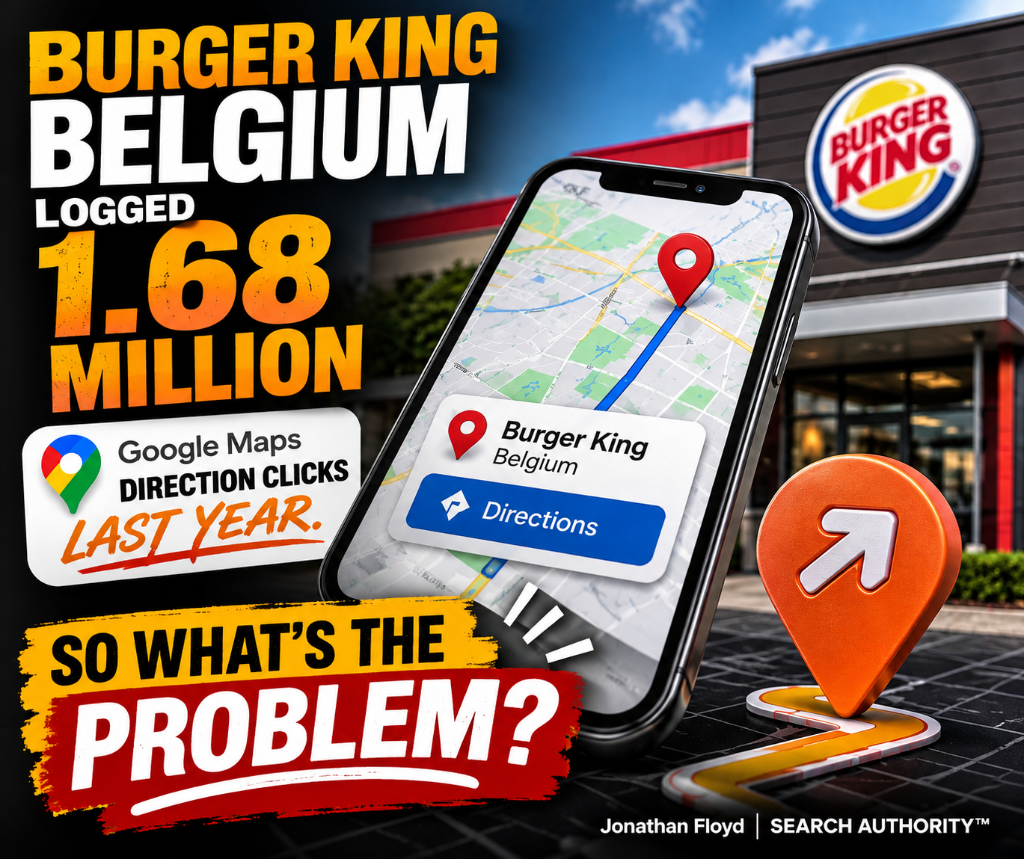
If you're shopping for an Uberall alternative, the fastest way to figure out what you're actually buying is to read one of their published case studies with a pen in your hand. So I did. On February 19, 2026, Uberall put out a customer story on Burger King Belgium covering 151 restaurants. The listings work in it is legitimately good. The reporting around it leaves out the four numbers I'd need to tell you whether the money worked, and that gap is the whole argument for hiring an operator instead of licensing software.
I've spent my career getting Google Business Profiles to rank. I run LeadValets out of St. Louis. I'm going to be fair to Uberall here, because there's no version of this where I pretend a company that manages listings for global brands is bad at managing listings. They aren't. But a case study is a sales document, and reading one properly means noticing what got measured and what quietly didn't.
What Burger King Belgium and Uberall got right
Credit where it's owed.
Uberall reported 1.68 million clicks on directions in Google Maps for Burger King Belgium, up 13% year over year, and 372,000 website clicks from the Business Profile, up 9%. Those are real numbers on a real footprint, and direction clicks in particular are about the closest proxy to a physical visit that Google gives you. If I'm running a restaurant group, that's the metric I want moving.
Their review operation is also genuinely strong. A 4.2 average star rating across the estate, an 88% reply rate, and a two-day average response time. I've audited multi-location accounts where the reply rate sat under 15% and the average response time was measured in months. Eighty-eight percent at that volume takes discipline, and Uberall's tooling clearly does the job.
The Local Pages piece is smart too. Building a dedicated, structured page for every single location and pointing the store locator at it is the right architecture. It gives you an owned URL per market instead of renting your entire local presence from a directory.
So: good listings hygiene, good reputation coverage, sound page architecture. If that's all you need, a platform will serve you.
Now the part that would have gotten a report handed back to me.
The four numbers that aren't in the case study
Direction clicks rose 13%. Website clicks rose 9%. Both are up. Neither tells me whether Uberall caused it.
Here's what's missing.
Rank. There is no keyword ranking data anywhere in that case study. Not average position, not share of voice, not a single geo-grid scan. For a document about local search performance, that's a striking omission. Rank is the leading indicator. Calls and direction requests are the lagging one. If your rank on "burger near me" in Antwerp improved, say so and show it. If it didn't, then the click growth came from somewhere else and we should talk about where.
Branded versus non-branded. This is the one that matters most and it's nowhere on the page. Burger King is one of the most recognized brands on earth. A large share of the searches producing those 1.68 million direction clicks were almost certainly people typing "burger king" and then a town name. That traffic exists because of television, because of the Whopper, because of decades of brand building. It is not evidence that a listings platform did anything. Split branded from non-branded and the picture either gets much more impressive or much less. Without the split, a 13% lift is unreadable.
A category baseline. Belgian quick-service restaurant search demand didn't sit still between 2024 and 2025. Neither did Google's own interface, which kept pushing more interaction into the results page. If the category grew 11% and Burger King grew 13%, that's a two-point win. Respectable, but a different conversation than "up 13%."
Cost. No spend, no cost per direction click, no revenue attribution, no return. The case study does point to page-level analytics on the local pages, the standard set: who landed, how long they stayed, how many bounced. That's web analytics. It tells you nothing about whether the contract paid for itself.
I want to be precise about what I'm claiming. I'm not saying the program failed. I have no idea whether it did, and neither do you, and that's exactly my point. Those four numbers are the difference between a marketing asset and an accounting one.
The citation tells you something
There's a line in the Uberall case study noting that 60% of searches end without a click. They link that claim to a blog post on an agency website rather than to the research it came from.
The underlying study is SparkToro's, run with clickstream data from Similarweb, and it's been the reference point on zero-click search for years. When Uberall published in February 2026, roughly 60% was a defensible figure. The 2024 study put US zero-click searches at 60.45%.
It isn't 60% anymore. On June 8, 2026, Rand Fishkin published the 2026 numbers: 68.01% of US Google searches ended without a click across January through April. That's 7.5 percentage points in two years, the fastest acceleration in a decade.
Two things follow.
The first is small and fixable. A case study built around AI search visibility should be citing the primary source, not somebody's recap of it, and it should get refreshed when the underlying number moves eight points. Google's own guidance on generative AI features stresses non-commodity content and accuracy. Secondhand citations of stale figures are how a page gets skipped by the AI answer engines it's trying to win.
The second is strategic and it's why I'm still bullish on local. In that same June study, Fishkin is blunt that a few categories still benefit from search: branded queries, local businesses, and high-intent transactional queries. Local is on the short list of things that still work while the open web loses clicks. If you own physical locations, your Google Business Profile is appreciating while everybody else's blog traffic craters. That's the trade I'd want every multi-location operator to understand.
A 151 that's also a 73
In the section introducing Burger King, the case study states the brand operates 151 locations across the country, then adds a parenthetical in bold saying 73 locations in Belgium and Luxembourg. Same sentence. Two different counts.
I'm not raising this to be petty about a typo. I'm raising it because of the argument the page itself makes a few sections later. Uberall's position is that giving every location its own structured page turns the brand into what they call an "owned source of truth," one that assistants will favor over a third-party directory. I agree with that completely. It's precisely why the contradiction matters. Consistent entity data is the whole game in AI retrieval. When a model reads the brand's own record and finds two different location counts inside a single sentence, you've given it a reason to go trust Yelp instead.
Nobody caught it. That's what happens when the vendor writes the report and the client approves the highlights.
What Google actually says moves a local ranking
I want to ground this in the primary source, because a lot of what gets sold as local SEO isn't in Google's documentation at all.
Google's own guidance says local results are based mainly on three things: relevance, distance, and prominence - the same three factors that determine who appears in the Google 3-pack. Relevance is how well your profile matches the query, which is a function of how complete and detailed your business information is. Distance is how far you are from the searcher. Prominence is how well known you are, and Google says that's informed by links to your business and by your review count and ratings - where velocity matters more than total volume.
The same page tells you to verify the business, keep information current, respond to reviews, add photos and video, and list in-store products if you're retail.
Then there's a line I wish every buyer read before their first vendor call. Google states plainly that there's no way to request or pay for better local ranking, and that they keep the algorithm details confidential on purpose.
Hold that thought.
On vendor scores that sound like Google scores
The Burger King case study leans on something called a Location Performance Score, an index across visibility, reputation, and engagement that flagged engagement as the brand's weak pillar.
I have no problem with the finding. Naming your client's weakest area in a public case study is more honest than most vendors manage, and I'd bet it's accurate.
My problem is with the category of metric. A Location Performance Score is a vendor's proprietary index. It is not a Google metric, it doesn't come from Google, and no third-party tool has access to Google's internal ranking systems. Google says as much in its guidance on third-party SEO tools. When a score improves, what improved is your standing inside that vendor's model.
Sometimes the model is a good proxy. Often it's a retention device, because a number that only your vendor can calculate is a number you can only keep watching by staying subscribed.
Ask any vendor, including me, one question: if I fired you tomorrow, which of these numbers could I still pull myself? Rank, calls, direction requests, and review rate all survive the breakup. Proprietary composite scores don't.
The textless review problem
This detail stuck with me. Sixty-nine percent of Burger King Belgium's reviews are textless star ratings, and that share climbed 24% from 2024. An AI assistant writes back to all of them so nobody goes unacknowledged. The case study offers two reasons for doing it: it keeps the team free for reviews that need a human, and it lifts what Uberall calls the location's "activity signals."
The first reason is sound. Nobody should be paying a person to type "thanks!" under thousands of silent five-star taps, and I'd automate it too.
The second reason is where I part ways. "Activity signals" is not a Google term. Google's documented position is that replying to reviews shows customers you value their feedback, and separately that review count and rating feed into prominence. Nowhere does Google publish a mechanism by which auto-thanking a wordless rating lifts your position. It might help. I've seen no evidence either way, and I'm not going to sell you a theory as a ranking factor.
So automate the 69%. Fine. But the 31% with actual words in them is where your operational intelligence lives, and it's where a generic AI reply does real damage. Someone wrote three sentences about a wrong order at a specific store on a Friday night. That's a manager conversation, not a template.
Software or an operator: the actual decision
nobody selling either one will tell you plainly.
Uberall sells a platform. Burger King Belgium's marketing team runs it. Someone at that company logs in, builds the posting calendar, reviews the AI replies, watches the score, and chases franchisees who won't update their hours. The software makes that person faster. It does not replace them, and the case study is upfront about the brand using the platform end to end, which means a trained internal team is doing the work.
That's a fine model if you have that team. A brand with 151 restaurants and a trade marketing department does.
Most companies don't. What I see constantly is a mid-sized operator with 20 or 60 or 200 locations who buys the platform, assigns it to a marketing coordinator who already has a full job, and watches it go stale in five months. The listings stay accurate, because that part is automated. Everything requiring judgment stops. Posts dry up. Review replies fall to the easy ones. Nobody has looked at rank since onboarding. The subscription renews anyway.
You didn't buy an outcome. You bought a tool and a second job - the same trap that catches businesses relying on paid ads instead of building organic search authority.
What I sell instead is the work. My team holds the login. We do the verification at volume, the duplicate and fake-listing cleanup, the content publishing, the review replies, the rank tracking, and the reporting. When a number moves the wrong way, chasing it is my problem, not something waiting in your coordinator's queue behind a trade show.
That's not a claim that my software is better than Uberall's. It's a claim about who's accountable on the Tuesday morning when your Dallas location gets suspended.
What I'd have put in that report
If Burger King Belgium were mine, the annual review would open with a page like this.
Average rank on a fixed keyword set, per location, measured on Google Search and Google Maps, this year against last. Geo-grid scans for the top five markets showing the streets where we own the pack and the ones where we vanish. Share of voice against a named competitor set. Non-branded direction clicks isolated from branded. Cost per incremental non-branded direction click. Review reply rate split between textless and text, because they're different jobs. And the list of locations that got worse, which every honest report has and almost no case study includes.
Then the click totals. Those are the outcome, and outcomes belong after the evidence, not instead of it.
I'd also put targets in writing before any of it, which brings me to the one commitment I'd make that a software license structurally can't. A platform can't promise you a ranking outcome, because it isn't doing the work. I can, after an audit, because I am.
What I won't do is forecast your numbers before I've seen them. Every agency deck you've read projects a multiple somebody invented in a spreadsheet. I measure your baseline first, agree the 90-day target off your actual data, and then sign up to it. If your category or footprint means local won't move enough to pay for me, I'll tell you that on the call and you can keep your money.
Who should buy which
I'd rather be useful than close everyone, so let me be direct about where a platform beats me.
Buy the software if you have 500-plus locations, an in-house local marketing function with dedicated headcount, and a franchise structure that needs self-serve access for owners. At that scale you need the infrastructure, you have the people to drive it, and an agency in the middle just adds a layer. Uberall, Yext, and the rest of that category exist for a reason and they're good at it.
Hire us if you have somewhere between a handful and a few hundred locations, nobody whose actual job title includes local search, and a board asking why the phone isn't ringing in three specific markets. That's the gap, and it's where most of the market actually sits.
One honest caveat on my side. I've built my practice on service businesses and local operators rather than global QSR estates, so if you're running 3,000 restaurants across nine countries I'm not your first call and I'll say so. Ask me for the reference in your own size band and your own category. If I can't produce one, that's your answer.
Read the next case study you're sent the way I read this one. Find the number that isn't there. Ask why.
Questions I get asked about this
What's the best Uberall alternative for a mid-sized multi-location business?
It depends on whether you need software or you need the work done. Uberall, Yext, PinMeTo, and Birdeye all compete on platform features, and if you have staff to run one, comparing them on price and directory coverage is the right exercise. If nobody at your company owns local search as their actual job, none of those are your answer, because the tool isn't the bottleneck. A managed provider that holds the login and reports on rank is.
Does a listings platform improve Google Business Profile rankings on its own?
Not on its own. Google says local ranking comes down to relevance, distance, and prominence - the same factors that drive "near me" search visibility. A platform helps with relevance by keeping your information complete and consistent, and it helps with prominence by making review replies manageable at volume. It can't change your distance from the searcher, and it won't publish location-specific content or chase a suspended listing unless somebody drives it.
How should I measure a local search program?
Average keyword rank per location on Search and Maps, non-branded direction requests, calls from the profile, review reply rate split between textless and text, and cost per incremental non-branded action. If your provider only reports total clicks and impressions, you cannot tell their contribution apart from your brand's.
Is Google Business Profile still worth investing in with AI search taking over?
More than before, in my view. SparkToro's 2026 research found 68.01% of US Google searches now end without a click - the fastest acceleration in a decade - and it names local businesses as one of the few categories still benefiting from search. The clicks are leaving the open web. The map pack is where they're going.